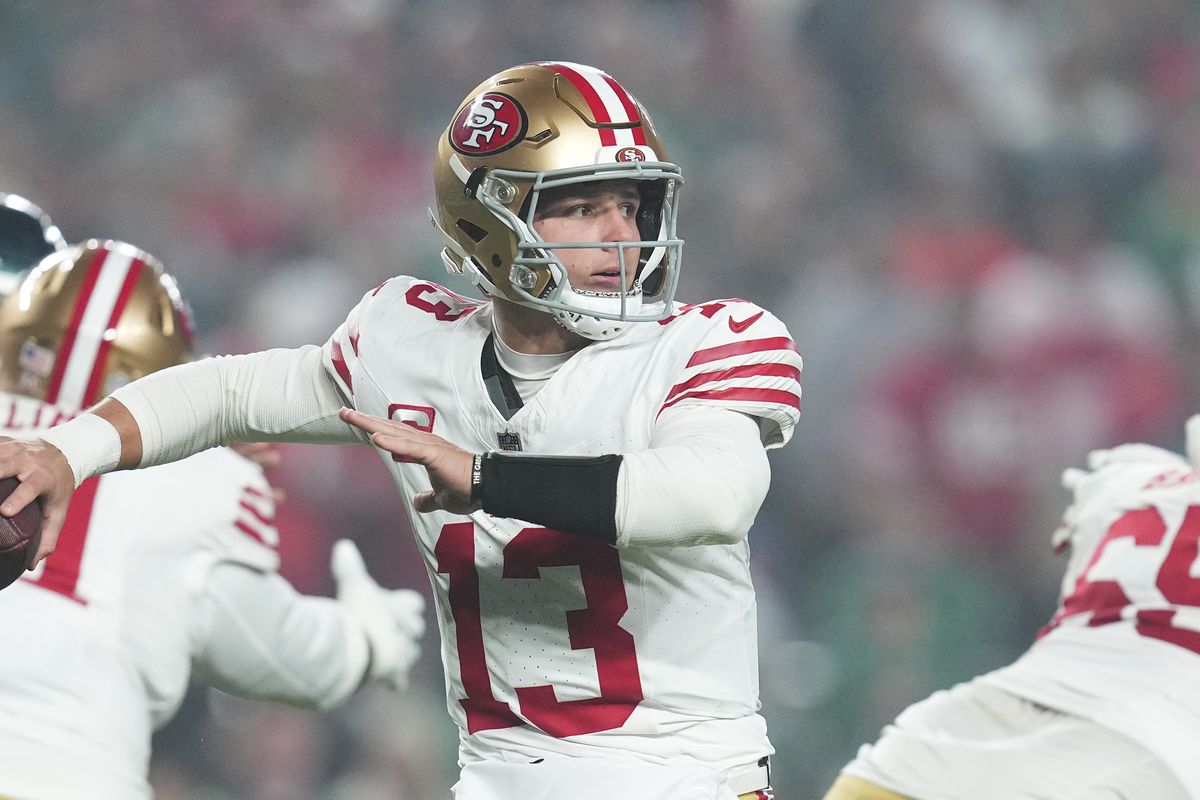
Aaron Rodgers: Front-runner Extraordinaire
Cold, Hard Football Facts for Sep 07, 2011
Cold, Hard Football Facts Deep Thinker
As the 2011 NFL season gets underway, you have probably become familiar with some of the exceptional feats Aaron Rodgers has accomplished for the Green Bay Packers since taking over for Brett Favre in 2008.
Rodgers is the league’s all-time highest rated passer in the regular season (98.4) and the postseason (112.6). He currently holds the record for lowest interception percentage (1.99%) in the regular season, as well as the highest touchdown-to-interception ratio (2.72). He is the reigning Super Bowl MVP.
He’s one of the most effective scramblers in the game, with the 2nd most rushing yards (879) and the most rushing touchdowns (13) from the quarterback position since 2008. He’s done it without a great offensive line, and a running game that averages just 90.2 yards per game.
What you may not know is that Aaron Rodgers is also the league’s best front-runner.
What’s a front-runner? There are multiple meanings, but we’ll focus on one in particular. The front-runner is a quarterback that plays on a balanced team, which often comes out and plays very well offensively, very well defensively, builds a large lead early, and cruises to a comfortable victory.
They don’t make many comeback victories. When they do, it’s often from a small deficit. They don’t often get involved in or win shootouts. When things go according to plan, they look like the most unbeatable team in the league. When they don’t, that is when the front-runner has serious problems, and the wins are vastly harder to come by.
Is being a front-runner a bad thing for Aaron Rodgers? We’ll examine that, and much more about his career to this point.
The 2011 Quarterback Climate
Front-runner has a few meanings. You could also say Rodgers is the front-runner, or the favorite, as we head into the season to win league MVP, or get his team back to the Super Bowl. You could call all the bandwagon fans and the football media pundits front-runners, in that they are flocking to the new best thing (as long as it’s winning).Rodgers is essentially Buzz Lightyear in the first Toy Story (utility belt swapped for a championship belt), and all the Andys out there are throwing old Woody to the side to make way for the new guy.
The problem is today’s NFL has multiple Woodys; quarterbacks with proven track records of winning and statistical success, plus at least one Super Bowl ring on their resume. It would be foolish to just throw Rodgers to the top of the class at this point.
In fact, you can say Rodgers is entering into a quarterback climate in 2011 that the NFL has never seen before in the Super Bowl era.
| Season | #SB QBs | Super Bowl Winning Quarterbacks | Avg. Age |
| 2011 | 6 | T.Brady, B.Roethlisberger, P.Manning, E.Manning, D.Brees, A.Rodgers | 31.3 |
| 2010 | 6 | B.Favre, T.Brady, B.Roethlisberger, P.Manning, E.Manning, D.Brees | 32.7 |
| 2006 | 6 | B.Favre, K.Warner, T.Dilfer, T.Brady, B.Johnson, B.Roethlisberger | 32.8 |
| 2009 | 6 | B.Favre, K.Warner, T.Brady, B.Roethlisberger, P.Manning, E.Manning | 33.0 |
| 2008 | 7 | B.Favre, K.Warner, T.Brady, B.Johnson, B.Roethlisberger, P.Manning, E.Manning | 33.1 |
| 1993 | 6 | J.Montana, J.McMahon, P.Simms, J.Hostetler, M.Rypien, T.Aikman | 33.3 |
| 2007 | 7 | B.Favre, K.Warner, T.Dilfer, T.Brady, B.Johnson, B.Roethlisberger, P.Manning | 33.4 |
The youngest group of those Super Bowl winners with an average age of 31.3 is the new 2011 class of six, which includes Rodgers, Drew Brees, Eli Manning, Peyton Manning (neck withstanding), Ben Roethlisberger, and Tom Brady. This must be the elite class Eli Manning was recently referring to.
Regardless of what you think of Eli, the others make up an impressive group of elite quarterbacks that are still either in or around their prime, and all playing at a high level. The league has never seen such a collection of active, elite quarterbacks still in their prime, and with a Super Bowl ring.
This doesn’t even consider the non-Super Bowl winning quarterbacks, such as statistical phenoms Philip Rivers and Tony Romo, or the likes of Matt Ryan, Michael Vick, Matt Schaub, Josh Freeman and Joe Flacco. That makes it hard to stand out in today’s NFL.
Thus far we have seen Rodgers pass for over 4,000 yards in a season, toss 30 touchdown passes, register a 100.0+ passer rating, and complete at least 65% of his passes in a season.
Problem is, in addition to the Super Bowl ring, we have seen Peyton Manning, Brady, Brees and Roethlisberger all do the same things statistically, and often more than once. Rivers and Romo also can claim the same numbers, but Rodgers has been able to separate himself from those two quarterbacks via the postseason success.
Rodgers’ statistics are gaudy, but also misleading. As Mike Tanier pointed out, Rodgers the starter has been all peak performance. He avoided the early struggles most young quarterbacks go through, and isn’t anywhere close to the physical decline phase of his career.
There are other factors at play statistically, such as Rodgers playing an easier schedule of pass defenses compared to his peers (see the fourth table). Adjusting for the opponent, Rodgers does not come out ahead of peers such as Manning and Brady (stay tuned during the season for a full expose on defense-adjusted passer rating).
A trend this researcher noticed as far back as 2008 was Rodgers completing an unusual number of passes on third down that were short of the first down. In some cases those are fine, such as making a field goal shorter or moving the team into field goal position, but often these are drive-ending plays that do nothing but boost your passer rating, a formula that obsessively loves completion percentage.
Third Down Passing
| QB | Years | Att. | Comp. | 1st Downs | %Comp, 1D | %1D |
| Peyton Manning | 2004-10 | 959 | 613 | 479 | 78.14 | 49.95 |
| Drew Brees | 2004-10 | 1008 | 651 | 476 | 73.12 | 47.22 |
| Ben Roethlisberger | 2004-10 | 837 | 513 | 387 | 75.44 | 46.24 |
| Philip Rivers | 2006-10 | 695 | 403 | 318 | 78.91 | 45.76 |
| Aaron Rodgers | 2008-10 | 443 | 282 | 199 | 70.57 | 44.92 |
| Tom Brady | 2004-10 | 807 | 473 | 362 | 76.53 | 44.86 |
Rodgers was fantastic on third down in 2009 (51.0% conversions), but regressed in 2010 to converting 40.8% (ranked 19th in the league) of his third down passes. You can see his conversion rate (last column) is on the lower end of the elites, and that only 70.57% of his completions gain a first down. That’s closer to Jason Campbell (66.4%) territory than it is elite territory. Campbell is notorious for throwing short passes on third down that have little to no chance of making a first down.
For Rodgers to get to the Manning/Rivers level (upwards of 78%) in completions for a first down, he would need to throw more long passes, which have a higher risk of being incomplete or even intercepted. You may decrease your passer rating, but we are talking about taking a chance to extend a drive.
As long as you don’t fall into the lure of “the new kid”, it’s a tough sell to put this three-year starter any higher in the top five. For as great as his brief career has been, he is far from perfect. Chalk it up to the downside of the front-running style.
The Historical Front-Running Quarterbacks
Who were some past great front-runners?Len Dawson was very successful at front-running with the Kansas City Chiefs, particularly in the 1960’s. In his first season with the team, they led the league in points scored and points allowed on their way to the 1962 AFL championship game. They jumped out to a 17-0 lead, only to see the Oilers force overtime behind a George Blanda rally. The Chiefs (then the Dallas Texans) won in double overtime on a field goal, as Len Dawson was an efficient 9/14 for 88 yards while handing off 49 times.
Dawson’s other championship season came in 1969, again with the #1 defense in the league, and a team that had the AFL’s best point differential. They jumped out to a 16-0 lead on the Vikings, significant in that the 1969 Vikings only trailed by more than 7 points (but no more than 10) just once during the season. The Chiefs won Super Bowl IV 23-7 and Dawson was named MVP.
Including the playoffs, Dawson started 167 games, winning 99 of them, and only having 11 wins via a fourth quarter comeback. The average deficit in those 11 comebacks was just 3.36 points, which is the second smallest average deficit of any quarterback with at least 11 comeback wins (Craig Morton – 3.27). The largest deficit was 7 points, overcame twice. Dawson was elected to the Hall of Fame in 1987.
Of the 45 Super Bowl champions, only three ever went the entire season without a single comeback win in the fourth quarter. They are the 1993 Cowboys, 2004 Patriots and 2010 Packers. Only six teams went the entire season with just one game-winning drive in the fourth quarter or overtime. They are the 1973 Dolphins, 1985 Bears, 1993 Cowboys, 1994 49ers, 1996 Packers, and 2010 Packers.
The 1990’s may have been the height of teams led by front-running quarterbacks. The Dallas Cowboys (Troy Aikman), San Francisco 49ers (Steve Young), and yes, the Green Bay Packers (Brett Favre) all built teams with Super Bowl-caliber offenses and defenses, with quarterbacks that could lead them to dominant victories. These were the only NFC teams that reached the Super Bowl from 1992 to 1997, and they often eliminated each other in the playoffs.
Troy Aikman had 16 comebacks (one more than Roger Staubach), but good luck finding anyone that can remember one of them besides the 1999 game in Washington. That was when Aikman threw five touchdown passes to erase a 21 point deficit in the fourth quarter, and win the game in overtime with a 76 yard touchdown to Rocket Ismail. Aikman spent his best years throwing the ball to Michael Irvin in the first half, and then handing off a lot to Emmitt Smith in the second half. That was the Dallas dynasty.
Steve Young is probably the best comparison to Aaron Rodgers. They both had to wait before replacing a legend, both play in the West Coast offense, and they both run well with the ball in addition to being highly efficient passers. Coincidentally, Young’s most memorable game-winning moment was against the Packers in the 1998 NFC Wild Card game; the touchdown pass to Terrell Owens with three seconds left.
Then there’s Brett Favre, the man Rodgers had to replace. When Favre was in his prime and winning MVP awards, the Packers were a strong front-runner team. During the 1995-1997 seasons, Favre won three MVP awards, reached the NFC Championship three times, started two Super Bowls, and was 44-13 as a starter. He had just one comeback win and two-game winning drives in those seasons. Favre’s shaky track record in these situations was well documented last season.
The 90’s ended with a bang as The Greatest Show on Turf took over, led by Kurt Warner. The Rams were a dominant team that year, and they did not register a comeback win until the NFC Championship against the Tampa Bay Buccaneers. Good timing. While the defense was the worst in the league in 2000, they enjoyed very strong defensive performances in 1999 and 2001, both years ending with trips to the Super Bowl. From 1999-2001 the Rams won 42 games, and only had three comebacks in the process.
Rodgers’ Case as a Front-Runner
How does Rodgers stack up? His team’s success the last two seasons has come on the strength of having one of the best offenses and defenses in the league, a common formula for a front-running team. They can jump out to that early lead by playing excellent on both sides of the ball.| Team | Years | 17+ Pt Wins | Lg. Rank | 21+ Pts 1stH | Lg. Rank |
| Green Bay | 2008-10 | 15 | 1st | 15 | 1st |
| St. Louis | 1999-01 | 21 | 1st | 22 | 1st |
| Green Bay | 1995-97 | 16 | 2nd | 16 | 3rd |
| Dallas | 1992-95 | 24 | 2nd | 13 | 3rd |
| San Francisco | 1991-98 | 51 | 1st | 47 | 1st |
| Kansas City | 1962-69 | 41 | 1st | 31 | 1st |
This shows how many games these teams were able to win by 17+ points (three-score game), and they all ranked in the top two in the league during these runs. 21+ Pts 1stH is the number of games in which they scored at least 21 points in the first half of a game, and again they all did it as often as anyone in their era.
Rodgers has won 31 games as a starter, registering just three comebacks and five game-winning drives, all against NFC North opponents (Detroit and Chicago). The “quality” of those wins raises some flags.
2008 – Both games were against the 0-16 Lions. In Detroit, the Packers actually had a 24-9 lead entering the final quarter. Detroit came back to take a 25-24 lead, Rodgers completed a 60 yard pass to Greg Jennings, which led to a go-ahead field goal. Jon Kitna threw two interceptions for touchdowns, and Green Bay won 48-25. In the rematch at Lambeau, Rodgers led a go ahead field goal drive to break a 14-14 tie in a game the Packers won 31-21.
2009 – On opening night against Chicago, down by two points, Rodgers threw a game-winning 50 yard touchdown pass to Greg Jennings with 1:11 left. For the rematch, down by one point, Rodgers only had to go 11 yards for a game-winning touchdown drive early in the fourth quarter.
2010 – In a must-win Week 17 game last year against the Bears, with the game tied, Rodgers threw for 71 yards on the drive, including the winning touchdown pass to Donald Lee with 12:42 left. Jay Cutler’s last gasp was intercepted to end the game, a 10-3 final, and clinch the sixth seed for Green Bay.
Three comebacks, each by a deficit of one or two points.
Fourth Quarter Wins
| QB | GS | Wins | 4th QT Wins | %Wins | 4QC | %Wins as 4QC | Avg. Deficit |
| Aaron Rodgers | 52 | 31 | 5 | 16.13 | 3 | 9.68 | 1.33 |
| Len Dawson | 167 | 99 | 18 | 18.18 | 11 | 11.11 | 3.36 |
| Kurt Warner | 129 | 76 | 14 | 18.42 | 9 | 11.84 | 2.22 |
| Steve Young | 157 | 102 | 18 | 17.65 | 14 | 13.73 | 6.57 |
| Brett Favre | 322 | 199 | 46 | 23.12 | 30 | 15.08 | 4.73 |
| Troy Aikman | 180 | 105 | 22 | 20.95 | 16 | 15.24 | 5.75 |
"4th QT Wins” represents the total number of games won in the fourth quarter with a comeback and/or game-winning drive. You can see Rodgers has the lowest percentage of his wins come in those ways. The average percentage of wins by comebacks is in the low-to-mid 20’s. You can also see Rodgers has the lowest average deficit overcome.
Can we rename Kurt Warner the “King of the Important One-Point Comeback”? Warner had 5 of his 9 comebacks from a deficit of just one point, but two of them were in NFC Championship games (against the 1999 Buccaneers and 2008 Eagles). He’s already the king of “other games of note” victories in the fourth quarter.
Perhaps some irony about Warner being king of the small comebacks is that he did bring his team back in two different Super Bowls from would-be records of 14 and 13 points, only to lose both games late after drives by Tom Brady and Ben Roethlisberger. He may have also had a 24-point comeback in the fourth quarter against the Saints in the 2000 Wild Card game, if only Az-Zahir Hakim did not muff the punt return late.
When informed via Twitter on his low number of fourth quarter wins, Kurt Warner offered this response:

It’s a very valid question, one for which we have the data to answer in great detail. Len Dawson not included, as we don’t have data that goes that far back. However we can get it for the other quarterbacks, as well as three quarterbacks with many comebacks (Peyton Manning, Dan Marino, John Elway), and three lesser quarterbacks from Rodgers’ 2005 draft class (Alex Smith, Jason Campbell, Kyle Orton).
Fourth Quarter Opportunities
| QB | 4QC Wins | 4QC Losses | % | GWD Wins | GWD Losses | % |
| Dan Marino | 36 | 46 | 0.439 | 51 | 50 | 0.505 |
| Peyton Manning | 35 | 42 | 0.455 | 46 | 46 | 0.500 |
| John Elway | 34 | 46 | 0.425 | 46 | 52 | 0.469 |
| Steve Young | 14 | 23 | 0.378 | 17 | 26 | 0.395 |
| Troy Aikman | 16 | 34 | 0.320 | 21 | 35 | 0.375 |
| Brett Favre | 30 | 72 | 0.294 | 45 | 75 | 0.375 |
| Alex Smith | 4 | 12 | 0.250 | 6 | 12 | 0.333 |
| Kurt Warner | 9 | 30 | 0.231 | 14 | 30 | 0.318 |
| Kyle Orton | 6 | 16 | 0.273 | 7 | 17 | 0.292 |
| Jason Campbell | 6 | 22 | 0.214 | 9 | 23 | 0.281 |
| Aaron Rodgers | 3 | 16 | 0.158 | 5 | 18 | 0.217 |
Lack of opportunity has not been the problem for these quarterbacks. About half the games in the NFL are close enough to see at least one team have the ball in the fourth quarter of a tied or one score game. Rodgers has the lowest winning percentage in these situations, lower than even Alex Smith.
Now hold on, you have to be saying, this isn’t detailing the performance of the quarterbacks in these situations. That is correct. You wouldn’t expect an Alex Smith drive to be nearly as QB-dependent as an Aaron Rodgers drive. That may be true to some extent, however Smith has actually led game-winning touchdown drives of 90 and 86 yards for two of his four comeback wins, and he was the driving force behind those drives. Even if they were NFC Worst (read: West) games, he has come through a few times.
What about factoring in “lost comebacks”? This would be similar to baseball’s blown saves: games where the quarterback did his job to lead a go ahead drive (a comeback), only to see the defense/special teams give up the lead and the team lost the game. Remember, Aaron Rodgers led a go-ahead drive in Pittsburgh in 2009, only to see Roethlisberger throw a game-winning touchdown on the final play of the game. That is a lost comeback. Rodgers already has four of them, one more than his actual comeback wins, which is practically unheard of. Let’s factor them into the percentages.
Adjusted Comeback Rate
| QB | 4QC Wins | 4QC Losses | Lost 4QC | TOT 4QC Wins | 4QC Losses | % |
| Peyton Manning | 35 | 42 | 7 | 42 | 35 | 0.545 |
| John Elway | 34 | 46 | 8 | 42 | 38 | 0.525 |
| Dan Marino | 36 | 46 | 7 | 43 | 39 | 0.524 |
| Steve Young | 14 | 23 | 5 | 19 | 18 | 0.514 |
| Troy Aikman | 16 | 34 | 4 | 20 | 30 | 0.400 |
| Brett Favre | 30 | 72 | 9 | 39 | 63 | 0.382 |
| Aaron Rodgers | 3 | 16 | 4 | 7 | 12 | 0.368 |
| Kurt Warner | 9 | 30 | 4 | 13 | 26 | 0.333 |
| Kyle Orton | 6 | 16 | 1 | 7 | 15 | 0.318 |
| Alex Smith | 4 | 12 | 0 | 4 | 12 | 0.250 |
| Jason Campbell | 6 | 22 | 1 | 7 | 21 | 0.250 |
This is more in line with the actual performance of the quarterback, though you can still see Rodgers is not in the elite territory. In fact he’s closest to Brett Favre, the player he replaced. Imagine that.
Mike McCarthy: Front-Runner Coach?
Last week we looked at underachieving teams, and both the 2008 and 2010 Packers appeared. This is a direct result of losing so many close games. Perhaps the epic struggles Green Bay has in winning close games is less about Aaron Rodgers, and more about Mike McCarthy’s coaching. Since taking over as head coach in 2006, the Packers have found winning games in the fourth quarter difficult to come by.| Fourth Quarter Comebacks & Game-Winning Drives, 2006-2010 | |||||||
| Team | Total Wins | 4QC | %Wins | Team | Total Wins | GWD | %Wins |
| Detroit | 18 | 8 | 44.4 | Tampa Bay | 35 | 17 | 48.6 |
| Tampa Bay | 35 | 13 | 37.1 | Buffalo | 31 | 14 | 45.2 |
| Denver | 36 | 12 | 33.3 | Detroit | 18 | 8 | 44.4 |
| Oakland | 24 | 8 | 33.3 | Jacksonville | 40 | 17 | 42.5 |
| Chicago | 50 | 16 | 32.0 | Denver | 36 | 15 | 41.7 |
| San Francisco | 33 | 10 | 30.3 | Kansas City | 29 | 12 | 41.4 |
| Carolina | 37 | 11 | 29.7 | Tennessee | 45 | 18 | 40.0 |
| Buffalo | 31 | 9 | 29.0 | Atlanta | 44 | 17 | 38.6 |
| Minnesota | 43 | 11 | 25.6 | Chicago | 50 | 19 | 38.0 |
| Jacksonville | 40 | 10 | 25.0 | Carolina | 37 | 14 | 37.8 |
| Cincinnati | 33 | 8 | 24.2 | Oakland | 24 | 9 | 37.5 |
| Kansas City | 29 | 7 | 24.1 | Cleveland | 28 | 10 | 35.7 |
| San Diego | 58 | 14 | 24.1 | Washington | 32 | 11 | 34.4 |
| Indianapolis | 67 | 16 | 23.9 | Pittsburgh | 56 | 19 | 33.9 |
| Seattle | 38 | 9 | 23.7 | San Francisco | 33 | 11 | 33.3 |
| Pittsburgh | 56 | 13 | 23.2 | Cincinnati | 33 | 11 | 33.3 |
| New York Giants | 52 | 12 | 23.1 | Minnesota | 43 | 14 | 32.6 |
| Atlanta | 44 | 10 | 22.7 | Houston | 37 | 12 | 32.4 |
| Dallas | 49 | 11 | 22.4 | Indianapolis | 67 | 21 | 31.3 |
| Tennessee | 45 | 10 | 22.2 | New Orleans | 53 | 16 | 30.2 |
| Washington | 32 | 7 | 21.9 | San Diego | 58 | 17 | 29.3 |
| Houston | 37 | 8 | 21.6 | Seattle | 38 | 11 | 28.9 |
| Cleveland | 28 | 6 | 21.4 | New York Jets | 47 | 13 | 27.7 |
| New Orleans | 53 | 11 | 20.8 | New York Giants | 52 | 14 | 26.9 |
| Philadelphia | 51 | 10 | 19.6 | Dallas | 49 | 13 | 26.5 |
| Arizona | 41 | 8 | 19.5 | Philadelphia | 51 | 13 | 25.5 |
| New England | 67 | 12 | 17.9 | Miami | 32 | 8 | 25.0 |
| New York Jets | 47 | 8 | 17.0 | Arizona | 41 | 10 | 24.4 |
| Miami | 32 | 5 | 15.6 | St. Louis | 21 | 5 | 23.8 |
| St. Louis | 21 | 3 | 14.3 | Baltimore | 54 | 12 | 22.2 |
| Baltimore | 54 | 7 | 13.0 | New England | 67 | 13 | 19.4 |
| Green Bay | 53 | 6 | 11.3 | Green Bay | 53 | 10 | 18.9 |
Since 2006, Green Bay has the lowest percentage of their wins resulting from a fourth quarter comeback or game-winning drive.
As shown above, lack of opportunity has not been the problem. The Packers have been an extremely competitive team in McCarthy’s tenure, having a realistic chance to win almost every game they have played in his five seasons.
Fewest Games Without 4QC/GWD Opportunity Since 2008
| Team | Total Losses | Games w/no 4QC/GWD opp. | % |
| Pittsburgh | 16 | 2 | 12.50 |
| Green Bay | 22 | 3 | 13.64 |
| San Diego | 20 | 4 | 20.00 |
| Baltimore | 19 | 4 | 21.05 |
| New YorkJets | 21 | 6 | 28.57 |
| New Orleans | 17 | 5 | 29.41 |
| Philadelphia | 20 | 6 | 30.00 |
| Indianapolis | 15 | 5 | 33.33 |
| New England | 15 | 7 | 46.67 |
| Atlanta | 17 | 9 | 52.94 |
Only the Steelers have done better the last three years at putting themselves in position to win games late. The Super Bowl XLV participants are well ahead the rest of the league here.
Interestingly enough, the worst loss of Rodgers’ career came at the hands of the Saints in his only meeting with them down in New Orleans on Monday Night Football back in 2008. The Packers trailed 45-21 after three quarters, never got closer than 16 in the fourth quarter, and lost 51-29. Keep that in mind for Thursday night when Green Bay hosts New Orleans.
While having your team competitive in almost every game is a great positive for Rodgers and McCarthy, it has been a negative on their records in winning the close games. You’re not going to win every close game, but isn’t it better to play well enough to have a chance than to be blown out? The latter doesn’t do any damage to their record in close games, but the former performed at a higher level. That matters. That is why it’s impossible to just kill Rodgers for his record here, because it is respectable how he always seems to give them a shot.
In games decided by 6 points or less, the Packers are just 7-15 (.318) since 2008, ranked 30th in the league. Only the Lions and Rams have a worse record.
Dating back to the 2007 NFC Championship, the Packers have lost their last six overtime games. That's not the record (the Patriots lost their first 10 OT games in franchise history.) However, this does make McCarthy the only head coach to lose six straight overtime games with the same team, and Aaron Rodgers the only quarterback to lose five straight OT games with the same team.
Have the Packers been unlucky? Mason Crosby has missed game-winning field goals from 51 and 52 yards. Hardly could be considered chip shots. Crosby had a 38 yard field goal blocked against the Bears in 2008. We mentioned the Roethlisberger winning pass to Mike Wallace with no time left in 2009. Even with Matt Flynn at quarterback last year, the Packers had two failed comebacks when facing a 4 point deficit, with a 4th & 1 situation against the Lions (incomplete pass) and Patriots (sacked on the last play of the game).
None of these things are that uncommon. Ask Houston fans about Kris Brown in the clutch, the Rosencopter disaster of 2008, or David Garrard’s deflected Hail Mary pass from last season. Now there’s some tragic “why us?” stuff.
Seizing the Moment
Rodgers and the Packers appear to have a bit of a problem with “seizing the moment”. They are pretty good at coming back on teams to tie the game, but when the time comes to win it, to seize the victory, they don’t play as well, and that can definitely help explain the overtime record and general record in close games.In the 2009 Wild Card playoff game against Arizona (a real front-runner battle with Warner), Rodgers started the game with an interception on his first pass. After falling behind 31-10, Rodgers led five straight touchdown drives to force overtime. If there was ever a game where you expected the coin-toss winner to win, this was that game. Green Bay got the ball first, but Rodgers immediately missed a wide open Greg Jennings down the field for what would have been the winning touchdown. On third down, Rodgers held onto the ball too long, was sacked, fumbled, and Arizona returned it for the game-ending touchdown.
How does one go from five straight touchdowns when playing from behind, to a drive like that when you have a chance to finally win?
There was even a great example from his college career of this disparity in performance.
In 2004 California lost just one game, to powerhouse USC on the road, 23-17. Rodgers was 14/14 passing in the first half. They trailed 23-17 to start the fourth quarter. He completed his first 23 passes. Rodgers fumbles on the first play of the fourth quarter. On the next drive, he throws his first two incompletions of the day in USC territory, and has to settle for a field goal, which is missed. One more chance. Rodgers was then 29/31 passing leading up to a 1st & goal at the 9 yard line in the final two minutes. But then he was sacked and threw three incompletions as USC won the game by six. Rodgers said “Anybody watching this game knows we really dominated the game. We just came up a little short in the score.” Does it all sound familiar by now?
Even in Super Bowl XLV, the Packers were in an interesting situation late in the game. Up by three, a touchdown would have iced the game. With a 1st-and-goal at the 8 yard line, Rodgers threw three passes, gaining three yards and misfiring on 3rd-and-goal. Rodgers rarely missed that night, but his overthrow to Nelson in the end zone led to a field goal, and the Steelers had life. Had Ben Roethlisberger led another classic touchdown drive to down the Packers late again, we’d be looking at another Green Bay meltdown that was completely avoidable. Fortunately for Rodgers, the defense came through this time, as they did in each of the last six games of the 2010 season.
The Defense’s Impact
When you look at Green Bay’s 31 wins under Rodgers, you see a lot of the same things. Half the time they win by three or more scores. Rodgers often puts up a 100.0+ passer rating, and they score a lot of points.We know they rarely win close games, but they also rarely win games in which they have allowed a lot of points. This is the last statistical piece we’ll look at, and it’s being presented because it is such a nice split of data heading into 2011.
Rodgers has started 52 games including the playoffs. In 26 of those games, the Packers have allowed fewer than 20 points (23-3 record). That means in the other 26 games, the Packers have allowed at least 20 points (8-18 record). A perfect 50/50 split.
The 23-3 record is typical for an elite quarterback. If you do not score at least 20 points in this league, you are going to have a hard time winning a game, let alone against a team with a great quarterback.
What’s interesting is the high scoring part, specifically the 8-18 (.308) record. That’s a sub-par number for such a quarterback, and makes Green Bay look decisively average in that department -- 24th in the league. Follow the link and notice where all the elite quarterbacks stand in win percentage on that list compared to Rodgers (especially the top four).
Green Bay loves to get ahead big, and stay ahead. That’s how they win. When they have to trade you blow for blow, or fall behind and need a comeback, those are usually the games they lose. No other team in the league today is this black and white when it comes to winning and losing. While Green Bay is not a team that can beat you in a variety of ways, their preferred method is one that's highly successful: top notch play from the quarterback, top notch play from the defense. That will beat a lot of teams in this league, and that's how Green Bay expects to perform each week
Is Front-Running Really a Bad Thing?
Quarterbacks such as Dawson, Young and Warner are either in the Hall of Fame and/or won multiple MVP awards. Not to mention they all won a Super Bowl, as Rodgers has already done. Obviously a front-runner can still be in the conversation for best quarterback in the league, though the talk about the best ever has usually shifted to guys that were more feared to beat you in a variety of ways. No one’s going to call a Sammy Baugh, Johnny Unitas, Joe Montana or Peyton Manning a front-runner.Joe Montana could beat you with an offensive explosion of 55 points, a four touchdown pass performance in a fourth quarter, or come all the way back from 28 points down. That’s just what Joe Montana did. That’s part of the reason most fans will take him over Steve Young.
Rodgers will have to improve in key situational areas if he wants to move up the ladder of the greatest quarterbacks ever. Fortunately, time is on his side. He’ll be 28 this season.
You could say Green Bay is a young team that’s just getting started. A front-runner in training, that may have figured it out beautifully for the playoff run last year.
They jumped out 14-0 on Philadelphia, hung on, then ended it by picking off Vick in the end zone. In Atlanta they put on an offensive performance that Montana and Young would relish, and blew out the Falcons 48-21. They jumped out 14-0 on Chicago, then put a wrap on it with a pick six of Caleb Hanie, and another pick later. They jumped up 14-0 early on Pittsburgh, thanks again to a pick six, and then finally stopped Roethlisberger on the last drive to win the Super Bowl.
Is it a repeatable strategy? Probably not, as that was a heavy reliance on key interceptions. But if they can figure it out and get more team performances like the Atlanta game, then this could be the league’s next dynasty.
You don’t have to win close games if you can consistently blow the opponent out. If Green Bay keeps their core together, finds eventual replacements for Donald Driver and Charles Woodson, then they could keep on dominating teams for the next several years behind the guidance of Rodgers. That’s the kind of team they’ve tried to build. That’s their style.
That’s front-running.
Scott Kacsmar is a football researcher/writer who has contributed large quantities of data to Pro-Football-Reference.com, including the only standardized database of fourth quarter comebacks and game-winning drives. He will be writing a weekly column entitled “Captain Comeback” for the Cold, Hard Football Facts this season. He does not expect to be mentioning Green Bay often as a winning team in it, but that’s okay. You can follow him on Twitter at @CaptainComeback.
Read more: Aaron Rodgers, Ben Roethlisberger, Drew Brees, Fourth Quarter Comebacks, Green Bay Packers, Kurt Warner, Mike McCarthy, New Orleans Saints, NFL, Peyton Manning, Philip Rivers, Statistics, Steve Young, Tom Brady
Forearm Shiver: the CHFF Blog
- Hockey Announcer Gone Wild: You Want To Party (Maybe) With This Guy
- Best Pass Defense Ever: Ronde Barber And The 2002 Tampa Bay Buccaneers
- Reese Witherspoon Arrest Video: Hot, Bothered And Handcuffed
- Sam Adams In A Can, Just In Time For Summer Drinking Season
- Live From Radio City: Reporter Punks NFL Draft Fans
Quick Outs
- The 5.0 Club: Best Rushing Teams in NFL History
- Sieves: The Worst Run Defenses In NFL History
- 2013 NFL Schedule: The Year Of The Denver Broncos
- Boston, Sports, Patriotism And Terror
- The 100 Stingiest Defenses In Football History
- NFL Crown Rule: Will It Dethrone Rushing King Adrian Peterson?
- Year Of The Offensive Tackle: Not Always The 'Safe' Draft Bet
- Draft Habits: NFL Teams Covet LBs, Duped By False Temptress WRs
- Big Tease: 2012 New England Patriots And NFL's History Of Offensive Failures
- Epic Fail: The Wide Receiver Draft Class Of 2012
Must See Videos